Colophons
Scribal and artistic completion statements that may name a copyist or artist, record a place and date, or mark the end of a manuscript with a distinctive layout.
Deuterocanonical and related texts
Some biblical manuscripts—including witnesses in the Masoretic tradition—preserve works outside the Jewish canon beside Scripture or its Aramaic Targum. This guide explains the texts, manuscripts, and scholarship, and updates automatically as occurrences are added.
3 texts · 9 occurrences · 6 manuscripts→ Duke of Sussex’s German Pentateuch (British Library Add MS 15282, 1300–1324)Folio 313 versoFolio 313v: the blessing at the end of Esther embeds the scribe's name, Ḥayim, before the haftarah cycle begins.Contains indexed biblical text→
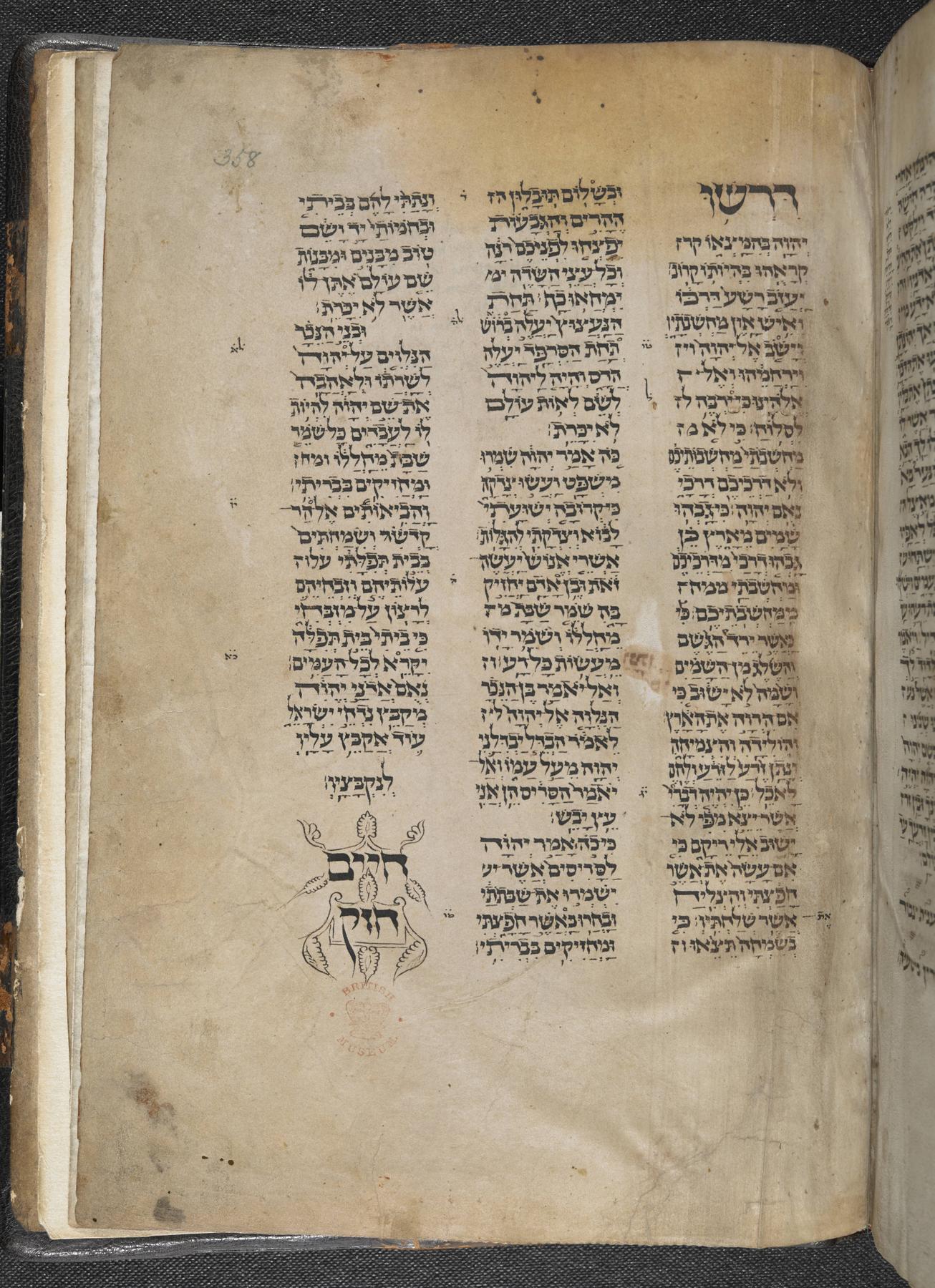 Duke of Sussex’s German Pentateuch (British Library Add MS 15282, 1300–1324)Folio 358 rectoFolio 358r: the final haftarah closes with the scribal signature חיים חזק, marking the end of the biblical production.Contains indexed biblical text→
 Rösel Bible (Berlin Mss. or. fol. 1–4)Volume 4 · fol. 294vVolume 4, fol. 294v: after the final verses of Chronicles, a narrowing completion block names Barukh ben Abraham and closes the four-volume witness.Contains indexed biblical text→
 LC Hebr. Ms. 158 (Aramaic Targums of the Five Scrolls and Job)Folio 30vFolio 30v: a dated completion statement by Menahem son of Peretz Trabot closes the Esther unit after the Aramaic Prayers of Mordecai and Esther.Contains indexed biblical text→
 LC Hebr. Ms. 158 (Aramaic Targums of the Five Scrolls and Job)Folio 41vFolio 41v: the final dated colophon closes Targum Job and names the manuscript’s completion context in Governolo in 1512.Contains indexed biblical text→
 Cambridge University Library MS Add. 1753 (Writings)Folio 142 recto · colophon and concluding Masoretic and biblical listsFolio 142r: a prose colophon block appears among concluding Masoretic and biblical lists; the digitization metadata associates the colophon with this opening.Contains indexed biblical text→
 Bodleian MS. Canonici Or. 87463rFolio 463r: the Hebrew colophon says that Yekutiel ben Solomon copied the Bible at Rimini for Benjamin ben Samuel around 1378; an Italian translation follows on the same non-biblical surface.No indexed biblical text→
 British Library Harley MS 1861 (1325–1349 Torah, Five Scrolls, haftarot, and Job)Folio 219 recto · Torah colophonFolio 219r: a completion statement closes the Pentateuch beside the end of Deuteronomy, naming Abraham in the manuscript’s scribal formulas.Contains indexed biblical text→
 British Library Harley MS 1861 (1325–1349 Torah, Five Scrolls, haftarot, and Job)Folio 288 recto · haftarah colophonFolio 288r: the haftarah collection closes with a distinct completion statement before the blank verso and the opening of Job on the following leaf.Contains indexed biblical text→
 British Library Harley MS 1861 (1325–1349 Torah, Five Scrolls, haftarot, and Job)Folio 310 verso · colophon and ownership notes · no indexed biblical textFolio 310v: a later completion statement and ownership notes occupy a post-biblical surface near the end of the physical volume.No indexed biblical text→
 Bodleian MS. Oppenheim 14fol. 345vFolio 345v: a scribal completion statement closes the Pentateuchal haftarot beside the final lines of Joshua 1:1–18.Contains indexed biblical text→
 Bodleian MS. Oppenheim 14fol. 351vFolio 351v: a second completion statement follows the end of Isaiah 66 on the final biblical surface, before the full-page principal colophon.Contains indexed biblical text→
 Bodleian MS. Oppenheim 14fol. 352rFolio 352r: Shlomo bar Eliezer Hayim ha-Kohen's monumental colophon names the patron Moses ben Judah, Albenc, and 6 Second Adar 5100 (6 February 1340), and records the completion of the Pentateuch, Scrolls, and haftarot.No indexed biblical text→
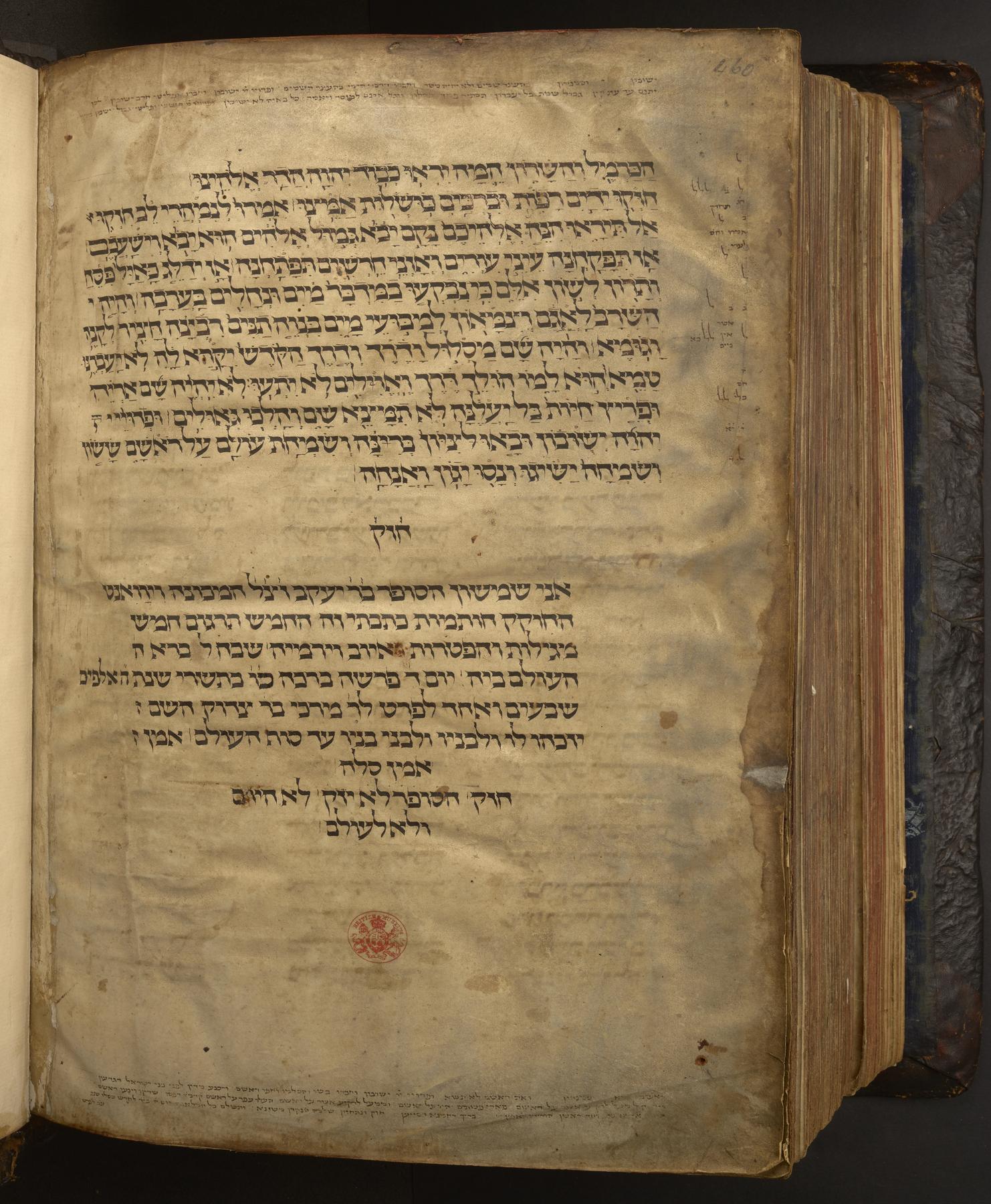 British Library Add MS 10455 (1310–1311 Torah, haftarot, and Writings)Folio 460 versoFolio 460v: the closing surface preserves dated completion statements for Shimshon ben Jacob's principal text and Solomon the Punctuator's later pointing and Masorah, ending the two-stage work in 1310–1311.Contains indexed biblical text→
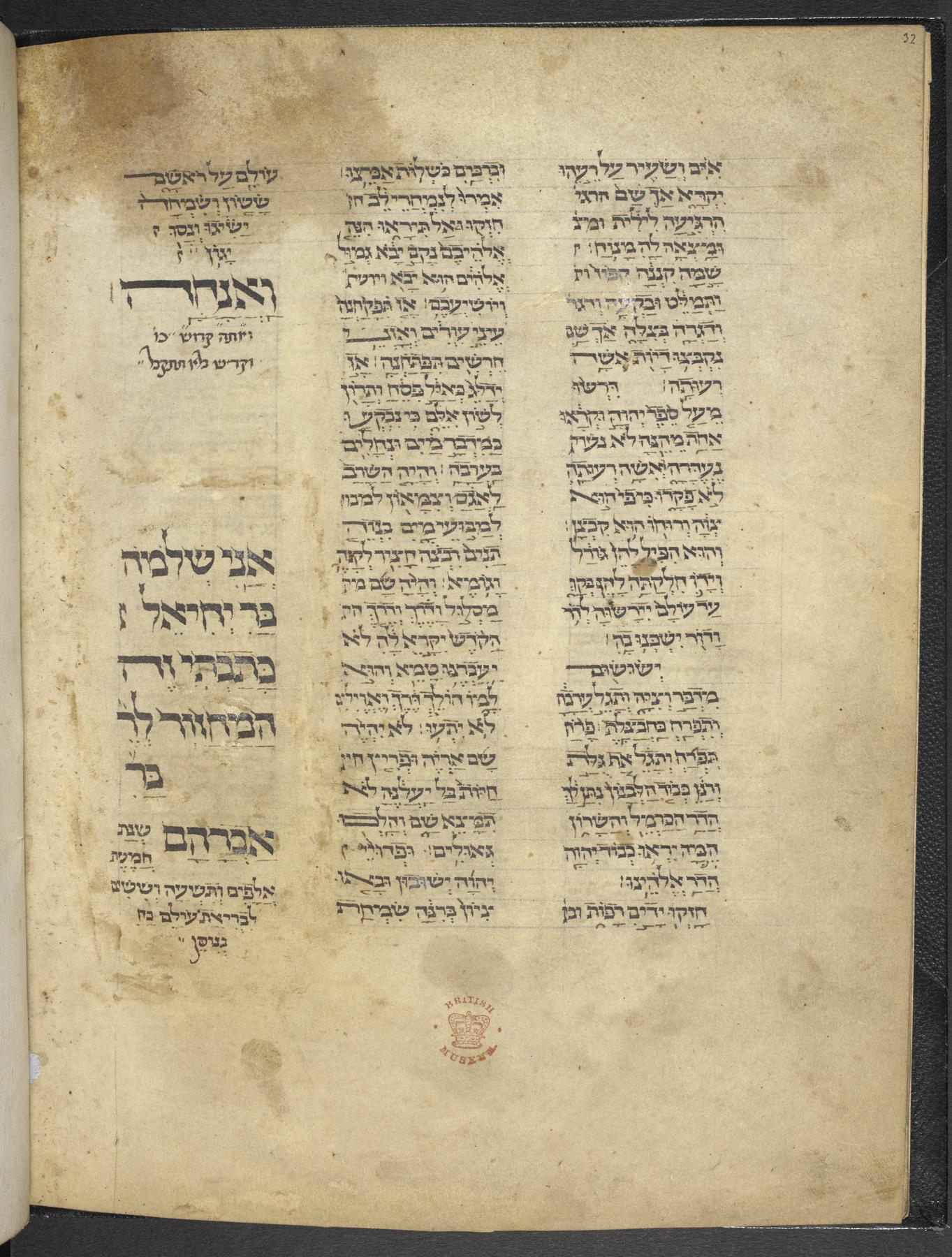 British Library Add MS 9405–9406 (1309 biblical readings from an Ashkenazi Maḥzor)Volume 2, folio 32 versoVolume 2, folio 32v: after the end of Isaiah 35, Solomon bar Jehiel’s bold multi-line subscription names the scribe and dates the parent Maḥzor to Nisan 5069 (1309 CE).Contains indexed biblical text→
 Codex Babylonicus Petropolitanus (Evr. I B 3)Manuscript folio 224vFolio 224v: Abraham ben Moses ha-Levi’s 916 CE scribal statement is enlarged into a monumental decorative block.No indexed biblical text→
 Manchester Rylands Genizah 2 (Jeremiah fragment)Leaf 1 verso — colophonLeaf 1 verso: an embellished 11-line colophon names Sahlan and dates the fragment to 953/954 CE.No indexed biblical text→
 Bodleian Library MS. Kennicott 1fol. 438rFolio 438r: the scribal colophon names Moses ibn Zabarah and records completion at La Coruña in 1476.No indexed biblical text→
 Bodleian Library MS. Kennicott 1fol. 446vFolio 446v: an unadorned colophon with the same Hebrew text as the ornamented colophon on fol. 447r, with a Latin version beneath.No indexed biblical text→
 Bodleian Library MS. Kennicott 1fol. 447rFolio 447r: a full-page artist’s colophon names Joseph ibn Hayyim.No indexed biblical text→
 Bodleian MS. Arch. Selden A. 47fol. 394vFolio 394v: Samuel son of Jacob Sarugiel's framed colophon records completion of the twenty-four books at Soria in 5064 AM (1303–1304 CE), beside the final lines of Nehemiah.Contains indexed biblical text→
 Bodleian MS. Canonici Or. 84216rFolio 216r: the final lines of 2 Chronicles 36:23 stand beside the dated scribal colophon, which records completion in Elul 5065 AM (1305 CE).Contains indexed biblical text→
 Bodleian MS. Arch. Selden A. sup. 106fol. 120rFolio 120r: David ben Isaac ha-Kohen writes his identity and completion statement in six monumental lines, saying that he completed a Pentateuch, the Five Scrolls, and haftarot; the page has no indexed biblical text.No indexed biblical text→
 Bodleian MS. Huntington 234fol. 176vFolio 176v: beside the end of the Isaiah commentary, Judah ben Joseph ben Alafons records that he completed the manuscript in Tevet 5090 AM (winter 1329–1330 CE).Contains indexed biblical text→
 Bodleian MS. Canonici Or. 138327rFolio 327r: a large scribal colophon dates completion to the first of Sivan 5064 AM (1304 CE); Deuteronomy 33:29 ends on the preceding fol. 326v.No indexed biblical text→
 Bodleian MS. Canon. Or. 91254vFolio 254v: a compact completion block marks the end of the Pentateuch beneath a multi-headed zoomorphic Masoretic design.Contains indexed biblical text→
 Bodleian MS. Canon. Or. 91307rFolio 307r: the illustrated final colophon names the scribe Judah ben Menahem; the dated manuscript statements record completion of copying on 4 Av 5064 AM (1304 CE) and completion of its pointing by Eliezer ben Yeshayah on 18 Sivan 5065 AM (1305 CE).No indexed biblical text→
Sources & method.
Manuscript images and metadata come from the holding institutions and digitisation projects listed below. Text and versification data come from UXLC, MAM, BIMA / Corpus Masoreticum, the Codex Sinaiticus Project, the DT-UCPH Samaritan Pentateuch, lxx-morph, and STEPBible. The viewer identifies the source used for each manuscript.
Page mapping and text recognition combine repository indexes, OCR, and transcriptions with kraken, Party, BiblIA, and other specialised HTR models. OpenAI Codex is used in developing the site and in running and reviewing this workflow.
Full source, credit, and licence links appear below.
Sources and licences
How to cite.
If Masoretica has facilitated your research, I would be grateful for a citation.
Preferred citation
Dershowitz, Idan. “Masoretica: Manuscript Explorer.” Accessed 17 August 2026. https://www.masoretica.org/.For a specific manuscript page, use its Cite button for the complete Masoretica and holding-institution citations. Pages using BIMA also include a BIMA citation, license link, and description of changes.