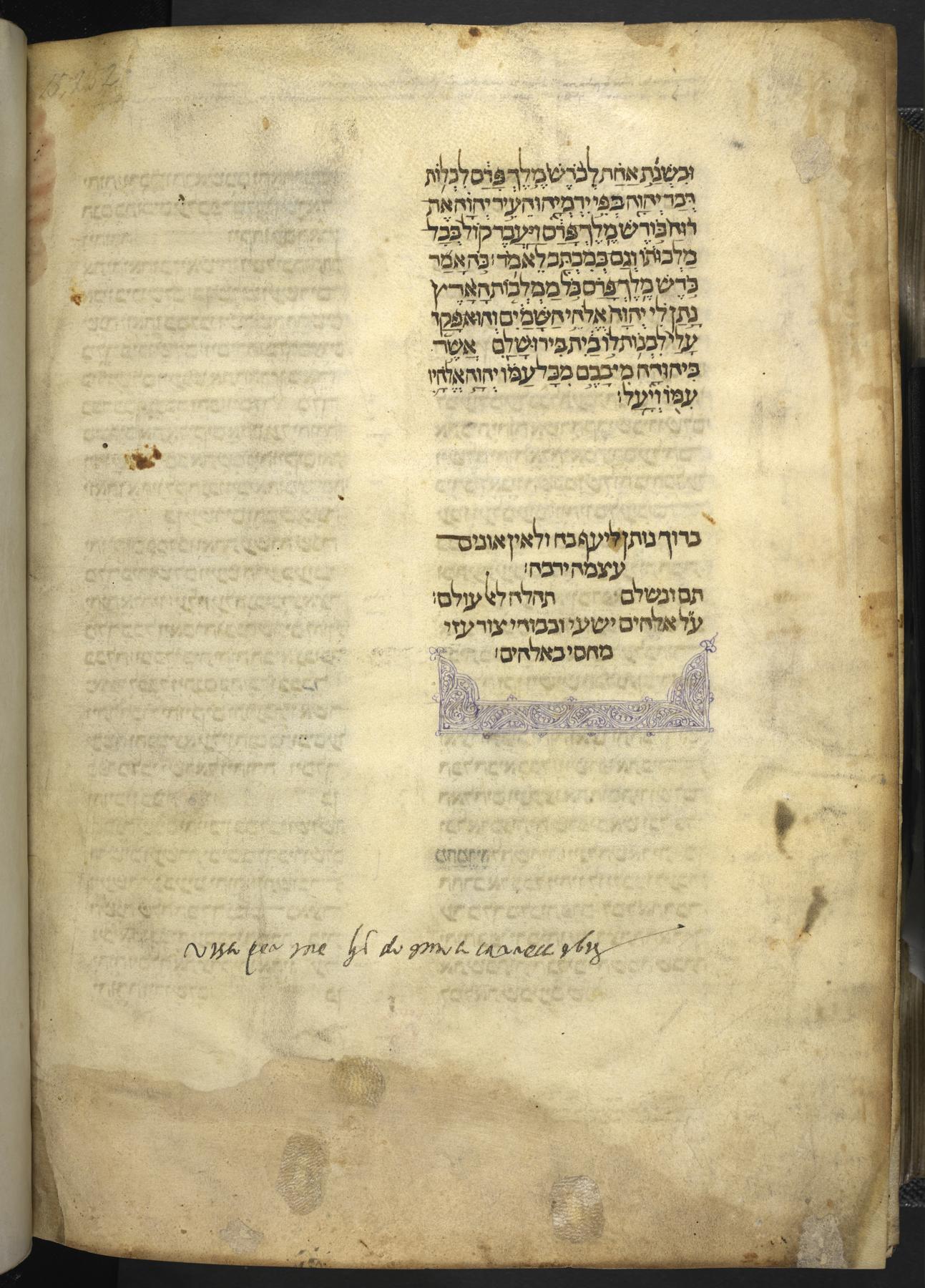
 masoretica · Duke of Sussex Bible (British Library Add MS 15252, 1350–1374)Folio 477v verso · Chronicles concludes; 1618 censor signatureFolio 477v: Giovanni Domenico Carretto's dated 1618 signature records an Italian censorship review on the final Chronicles surface.Open page →
Manuscript features
Curated selections appear first, followed by additional observations.
Pages carrying documented censor signatures or records of censorship review.
5 observations
masoretica · Duke of Sussex Bible (British Library Add MS 15252, 1350–1374)Folio 477v verso · Chronicles concludes; 1618 censor signatureFolio 477v: Giovanni Domenico Carretto's dated 1618 signature records an Italian censorship review on the final Chronicles surface.Open page → masoretica · Harley Catalan Bible (British Library Harley MS 1528, 1325–1374)Folio 422 verso · Chronicles concludes; censor inscriptionsFolio 422v: Jacob Geraldino's dated 1555 review and Luigi da Bologna's 1602 Reggio signature record two later censorship examinations on the final Chronicles surface.Open page →
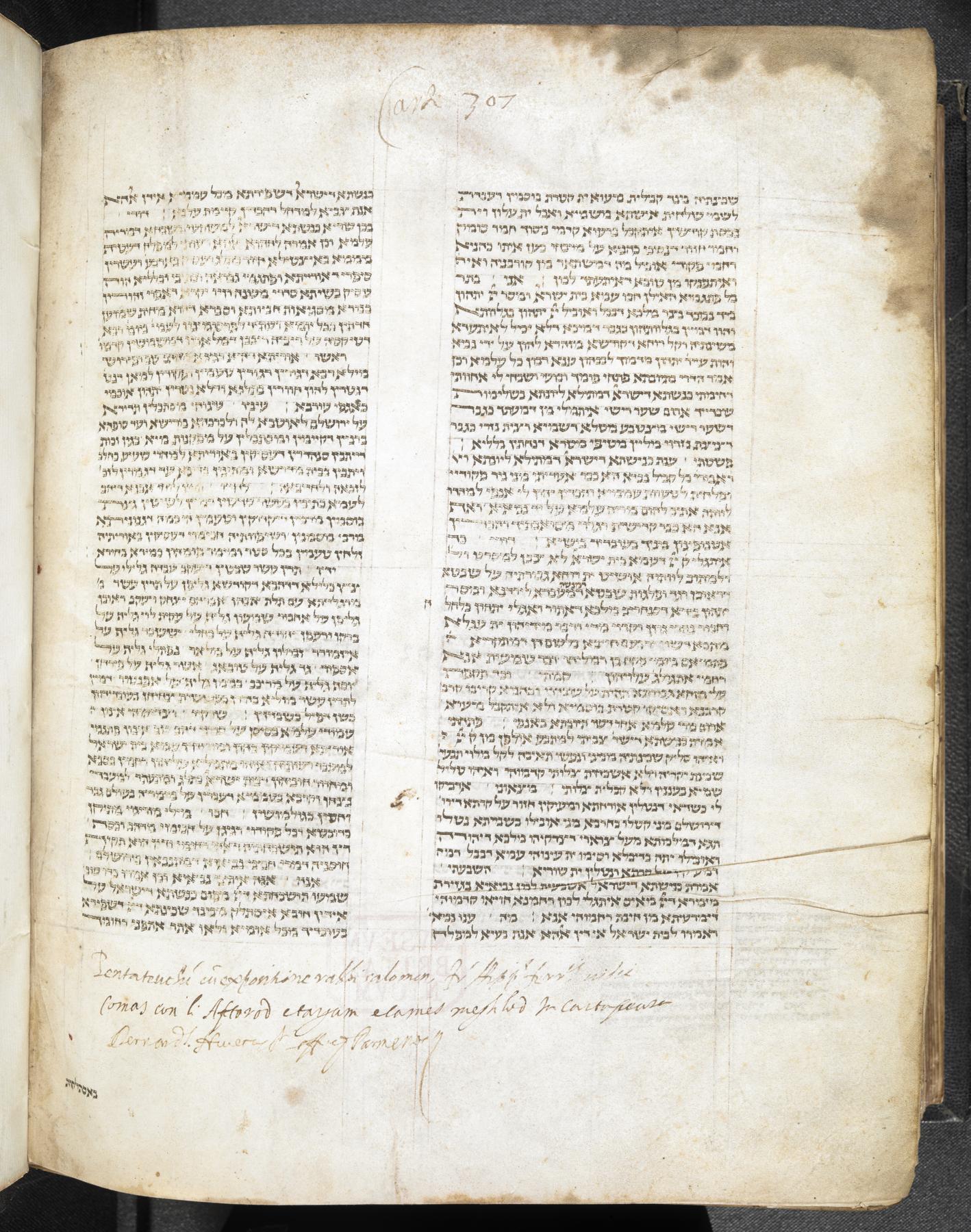 masoretica · British Library Harley MS 5709 (1300–1339 Torah, Five Scrolls, and haftarot with Rashi)Folio 323 verso · Latin censor inscription · partial Aramaic Targum on Song of Songs · no indexed Hebrew biblical textFolio 323v bears the Latin inscription ‘Fra Hipp. Ferr’, probably the mark of the Franciscan censor Hippolite of Ferrara, recording an early-modern review of the manuscript.Open page →
 masoretica · Bodleian MS. Canon. Or. 136353vFolio 353v bears the 1601 signature of Hippolitus of Ferrara, recording an early-modern censorship review.Open page →
 masoretica · Bodleian MS. Oppenheim 14fol. 351vFolio 351v: the final Isaiah reading is followed by Camillo Jaghel's dated 1611 signature, recording an early-modern censorship review on the last biblical surface.Open page →
Deuterocanonical and related texts
Some biblical manuscripts—including witnesses in the Masoretic tradition—preserve works outside the Jewish canon beside Scripture or its Aramaic Targum. This guide explains the texts, manuscripts, and scholarship, and updates automatically as occurrences are added.
3 texts · 9 occurrences · 6 manuscripts→About Masoretica
Sources & method.
Manuscript images and metadata come from the holding institutions and digitisation projects listed below. Text and versification data come from UXLC, MAM, BIMA / Corpus Masoreticum, the Codex Sinaiticus Project, the DT-UCPH Samaritan Pentateuch, lxx-morph, and STEPBible. The viewer identifies the source used for each manuscript.
Page mapping and text recognition combine repository indexes, OCR, and transcriptions with kraken, Party, BiblIA, and other specialised HTR models. OpenAI Codex is used in developing the site and in running and reviewing this workflow.
Full source, credit, and licence links appear below.
Sources and licences
UXLC Leningrad index Leningrad scan Leningrad photography credit Aleppo page index Aleppo facsimile Codex Sassoon 1053 page index Sassoon scan Sassoon catalogue Rylands Samaritan scan Rylands Samaritan MS 2 scan Rylands Samaritan MS 4 scan Gaster Samaritan MS 1133 scan Gaster Trilingual Samaritan MS 814 scan Gaster Samaritan MS Add 1 scan Gaster Samaritan MS 1858 scan Bodley Or. 699 Samaritan scan Bodley Or. 23 Isaiah scan Kennicott 1 scan Kennicott 2 scan Kennicott 3 scan Kennicott 4 scan Kennicott 5 scan Kennicott 6 scan Kennicott 7 scan Kennicott 8 scan kraken OCR and HTR toolkit Party multilingual HTR model used for Alexandrinus BiblIA medieval Hebrew model Samaritan kraken model Greek minuscule kraken model Sinaiticus line-segmentation model Miqra according to the Masorah text BIMA / Corpus Masoreticum manuscript transcriptions · CC BY-SA 4.0 Samaritan Pentateuch reference text Alexandrinus facsimile Rahlfs 82 catalogue Rahlfs 82 digitization Vaticanus facsimile Sinaiticus edition Sinaiticus electronic transcription Septuagint reference text Greek–Hebrew verse-number crosswalk Keter Aram Tsova typeface
For scholarly use
How to cite.
If Masoretica has facilitated your research, I would be grateful for a citation.
Preferred citation
Dershowitz, Idan. “Masoretica: Manuscript Explorer.” Accessed 12 October 2026. https://www.masoretica.org/.For a specific manuscript page, use its Cite button for the complete Masoretica and holding-institution citations. Pages using BIMA also include a BIMA citation, license link, and description of changes.